JTS .177 Pellets Have Landed. About Time. Here is a whistle-stop tour of what we have found.

You might already be familiar with JTS pellets in .22, which have been quietly doing the rounds for a while now. But the big news is this: JTS .177 pellets have finally arrived, and we wanted to take a closer look before everyone starts filling in their pellet testing spreadsheets.
JTS have been teasing .177 since the .22 variants landed back in 2023. The delay has been painful, especially in the UK, where sub-12 shooters overwhelmingly run .177. We are talking roughly an 80/20 split. The demand has been there for years. Export issues slowed everything down, but as we roll into 2026, it looks like the UK importer finally has a steady supply sorted. First impressions? Pretty damn good.

Are They Just Rebranded QYS? The Rumour Mill Spins On
There’s been plenty of speculation that JTS pellets are made by the same people behind QYS. On the surface, you can see why. Both are Chinese-made pellets, with similar tin styles and finishes. Easy conclusion, right?
Not so fast.
JTS have gone on record stating that their pellets are the result of what they describe as a multinational project to commission proprietary equipment to ensure consumers receive acceptable products. That quote originally appeared via Airgun World when reviewing the .22 pellets. You can read that piece here: Airgun World review of JTS .22 pellets
There’s nothing to suggest the .177 pellets are made differently from the .22s, and nothing to confirm otherwise. Until someone names the factory, all we really have is JTS’s assurance that they are not QYS OEM. That said, no one would exactly be outraged if they were, given how well QYS pellets have performed.
Tins, Branding and Model Numbers
The tins carry the JTS branding, alongside Xisco USA, which longtime shooters may recognise as the brand’s earlier identity. Model numbers are:
JAC129 for the standard weight
JAC131 for the heavy
Before anyone panics, JAC130 is not a missing head size. It appears to relate to blister or hanging retail packaging rather than a different pellet spec.
First Look Inside the Tin
Crack the tin and you’ll notice a darker finish than you see on many European pellets. There is a light coating of lubricant present. While some might assume PTFE or friction-reducing compounds, this is far more likely intended to prevent oxidation.
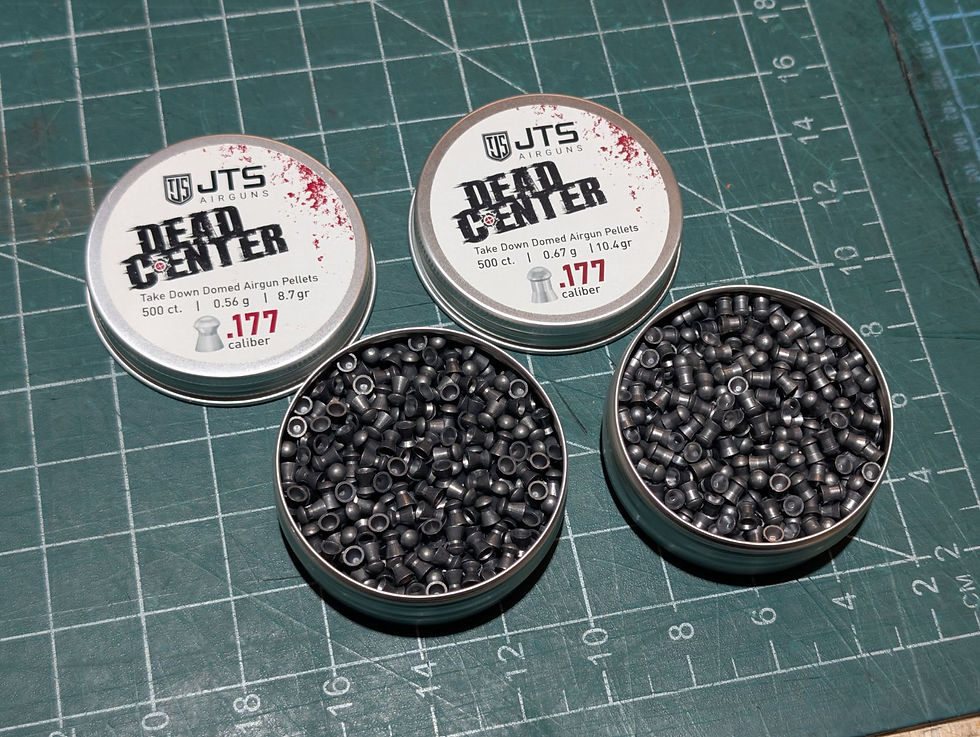
Quick science detour, because this matters: If you’ve ever opened a tin and found pellets turning pale grey or white, that’s surface corrosion. Typically lead carbonate (PbCO₃) or lead sulfate (PbSO₄). When corroded lead passes through a steel barrel, it can actually promote barrel corrosion rather than protect it. Over time, that absolutely will hurt accuracy and in extreme cases, damage the barrel. A thin layer of clean lead in a barrel is fine. Corroded lead is not. So yes, coatings matter. If you clean pellets, remember to re-coat them if you’re storing them in damp or draughty environments. Lesson over.
Pellet Hardness and Material Choices
Like many Chinese pellets, these feel slightly harder than typical European offerings. That’s almost certainly due to antimony content.
Whilst the exact alloy of lead used is always a secret amongst pellet manufacturers, Antimony increases hardness in lead alloys and gives pellets that slightly silvery finish. More importantly, it’s extremely heat-resistant. Manufacturers moved away from tin in swaging because, as you swage the pellets, the pressure causes heat, which can lead to deformation during the forming process. So manufacturers substituted in animony as a means to reduce deformation during pressing, and the result is a harder pellet with better pellet-to-pellet consistency and fewer damaged pellets after international shipping.
That trade-off seems intentional here.
Weight Consistency: Better Than Expected

JTS Dead Center 8.7gr .177 Pellets 
JTS Dead Center Heavy 10.4gr .177 Pellets
Weight-wise, the standard pellets run slightly heavier while the heavies are slightly under tin weight. Across 5 tins, we measured a 0.06/0.04 grain variance, which is genuinely respectable. Is that a statistically massive sample size? No. But it’s a solid indicator of what you can expect batch to batch.
Head Size, Measurement Reality and Why It's Not the Easiest Thing to Do
Measuring pellet head size accurately is a nightmare. At this scale, error margins matter.
To put it in perspective, a 10 micron error on a 4.50 mm pellet is around 0.22%. Most digital callipers only resolve to 0.01 mm, and lead pellets deform easily during measurement anyway.

JTS Dead Center 8.7gr .177 Pellets 
JTS Dead Center Heavy 10.4gr .177 Pellets
With all that in mind, using both digital callipers and a micrometre, we found:
Standard .177 averaging just under 4.498 mm
Heavy .177 slightly smaller at around 4.495 mm
So yes, calling them 4.50 head size is fair. Spot checks across additional pellets showed variance from 4.485 mm to 4.502 mm. Not Olympic grade, but absolutely competitive in this price and origin bracket.
Pellet Profile and Intended Use

JTS Dead Center 8.7gr .177 Pellets 
JTS Dead Center Heavy 10.4gr .177 Pellets
The standard weight pellet uses a traditional domed diabolo profile. This is your general-purpose hybrid pellet, forgiving in choked barrels and suitable for most rifles.
The heavy pellet is more interesting. It has a semi-slug profile, with added mass filling in around the waist. This design may prefer shallower choked barrels but should perform well in spring-loaded self-indexing magazines, where consistent feeding matters, thanks to that chunkier and less squashible design.
Final Thoughts
On first inspection, the JTS .177 pellets look well-made, consistent, and sensibly designed. They are not pretending to be Olympic match pellets, but they are clearly aiming to punch well above entry level.
Now it’s over to you. Will they earn a permanent place in your pellet testing sheets, or will they get benched after one range session?
Let us know in the comments below.
---------------------------------------------------
Think we missed something? Let us know in the comments below.
---------------------------------------------------
Support this blog by buying the blog writer a coffee!
---------------------------------------------------
*Please note that some of the links may be Amazon affiliate links, which means we may earn a small commission from your purchase. Affiliate links help support our blog and the valuable information we provide.
Image Use for Educational Purposes - This blog post includes images used for educational purposes, not all of which are not owned by the publisher. Efforts have been made to credit image owners/sources appropriately, and any concerns about attribution or copyright should be addressed by contacting us. These images are used solely for educational purposes within fair use guidelines, with no commercial intent. The inclusion of external images does not imply endorsement or sponsorship of our content by image owners/sources. We aim to comply with relevant copyright laws.


I have used these in my BSA R10se in 8.7 grain for both general target work and pest control with very good, accurate results. The only gripe I have is that I run a digital scope and there is no Ballistic Coefficient of the pellet on the tin (as with most makes pellets) and it was a pain finding it. Come on JTS, put the BC on the tin and stand further out of the crowd.
I used these pellets a couple of years ago (in .177 cal) when they first appeared, and also when they had a light price tag.
They were superb pellets and VERY accurate... Not fussy about which barrels they went through.
And then, sadly, the .177 cal ones disappeared from the shops.
They are definitely worth trying... Let's hope the prices haven't gone silly.