There is always a "but" when you're buying something designed primarily to look like something else.
Replica airguns and airsoft guns exist in a slightly strange corner of the shooting world. They can be incredibly realistic, great fun to shoot and, in some cases, surprisingly capable. But they are still compromises. You're trading some performance, efficiency and sometimes reliability for something that looks and handles like the real thing. And that's perfectly fine.
The mistake is expecting a replica to behave like a purpose-built target airgun simply because both happen to launch something downrange.
If You Want a Replica, Buy a Replica
If you're looking for something to display, collect or simply own because you've always fancied a particular firearm, there's absolutely nothing wrong with buying a replica.
In fact, that's probably the best reason to buy one.
The problem comes when someone buys a replica as their first ever airgun because they assume that because it looks like a Glock, SIG, CZ or Beretta, it's going to be the best way to learn how to shoot. It probably isn't.
A purpose-built air pistol has been designed around shooting. A replica has been designed around looking, feeling and operating like something else, with shooting performance being part of the compromise.
One of the best rules we've found when comparing conventional airguns with replicas is:
If it looks like, or is trying to imitate, a real firearm, it's probably going to perform worse than something that doesn't.
That doesn't mean the replica is bad. It means you've bought a replica.
If you buy a sports car and complain that it doesn't carry six people and a washing machine, the problem isn't necessarily the car. You've just bought the wrong thing for the job.
What About Airsoft?
This is where the distinction becomes rather more obvious.
If you're buying an airsoft replica because you actually intend to play airsoft and you're legally able to purchase the realistic replica you're looking at, then congratulations, you're doing exactly what the product was designed for.
Airsoft replicas are built around the experience of handling and using a realistic platform in a game environment. They don't need to compete with a target pistol for pellet-on-paper accuracy because that isn't the point.
If, however, you're buying an airsoft replica purely because you want something realistic to display at home, the situation is slightly different.
UK law places restrictions around realistic imitation firearms, which means you can't simply decide that you'd like a realistic black replica for the wall and order one because it looks cool.
Which is slightly unfortunate if your entire plan was to recreate your own little armoury.
The Great Pellet Replica Myth
This is where things get particularly interesting.
There has been a long-running belief that if a replica shoots pellets rather than BBs, it must automatically be more accurate and more powerful.
Because pellets are better.
Everyone knows pellets are better.
Except... we've actually tested this.
And the results aren't nearly as straightforward as the internet would have you believe.
A lot of people who complain that a new replica is "only" available in 4.5mm BB rather than .177 pellet will tell you that the pellet version would obviously be more accurate, have better range and produce more power.
The problem is that 4.5mm BB and .177 pellet aren't interchangeable measures of performance.
The projectile is only one part of the equation. The barrel, power plant, valve, action, ammunition, hop-up, gas system and overall design all contribute to what actually happens when you pull the trigger.
And with replicas, the results can be rather surprising. In our experience, a good BB replica can outperform a pellet replica in range, usable accuracy and sometimes power, particularly where the BB one incorporates a hop-up system.
That sounds backwards if you've spent years being told that pellets are automatically the superior projectile.
They aren't.
They're simply different.
Why Does Hop-Up Matter?
Airsoft has been using hop-up systems for decades, but we're now seeing the technology appear on more 4.5mm BB air guns.
The principle is relatively simple. A small contact point applies friction to the top of the BB as it travels through the barrel, imparting backspin.
That backspin changes how the BB behaves in flight, helping it maintain a flatter trajectory and extending its useful range.
This is one reason something like a BB pistol with a properly configured hop-up can be surprisingly capable for what is, ultimately, a replica pistol.
It also explains why simply saying "pellets are more accurate than BBs" doesn't really tell you anything useful.
The gun matters.
The projectile matters.
The way the gun interacts with that projectile matters.
And, occasionally, reality refuses to cooperate with something somebody read on Facebook eight years ago.
Where Pellets Do Have an Advantage
There is one area where pellet replicas generally have a fairly obvious advantage. Ricochets.
A pellet is designed to deform when it hits a suitable target and backstop. A steel BB, unsurprisingly, is a little more enthusiastic about bouncing off things.
That makes pellets the more sensible choice in situations where BBs aren't appropriate or where a particular range doesn't permit them.
But that doesn't automatically make a pellet replica the superior target pistol.
If your goal is to shoot a replica at 10m and achieve the smallest possible groups, you might find that a purpose-built target pistol is a considerably better starting point.
And if you're absolutely determined that the pistol must look like a Glock while also producing target-pistol levels of accuracy, we have some bad news. You're asking the replica to do something it wasn't designed to do.
So What About Revolvers?
Interestingly, if you're looking specifically at replica air pistols and want the best combination of realism and shooting performance, revolvers deserve some consideration.
People seem to have an odd tendency to overlook them.
A good CO2 revolver doesn't need to divert gas into operating a blowback slide, so more of the available gas can be used to propel the projectile.
They also don't have the slightly strange compromise of a non-blowback semi-auto replica, where you've got a realistic-looking pistol that doesn't actually cycle.
A revolver can therefore be a rather clever middle ground.
You get something that looks and operates like a firearm, while avoiding some of the compromises found in semi-automatic replica pistols.
They're also quite entertaining.
Which, let's be honest, is one of the reasons we're here.
So, Should You Buy One?
If you want a replica because you like the look, feel, history or mechanical operation of a particular firearm, yes.
If you want something to hang on the wall, yes.
If you're buying an airsoft replica because you're going skirmishing, yes.
If you're buying your first ever airgun and your primary objective is learning to shoot accurately, we'd suggest looking beyond the replica section.
And if you're buying a pellet replica because you have convinced yourself that "pellet automatically means better", we'd suggest doing a little more research first.
The fundamental compromise with replicas is always going to be the same:
You are prioritising the experience of owning and shooting something that looks like the real thing over pure shooting performance.
There's nothing wrong with that.
In fact, that's exactly why replicas are so much fun.
Just don't buy a replica, shoot a 20cm group at 10m and then complain that your £150 replica Glock isn't behaving like a £1,000 target pistol.
That's rather like buying a scale model Ferrari and getting annoyed that it won't pass its MOT.
A Few of Our Favourites
These aren't necessarily the "best" replicas, and we're certainly not ranking them. They're simply some of the ones our team would happily buy because they each do something particularly well.
The CZ Shadow 2 has an excellent trigger system, rapid blowback and a convincing overall design. It also incorporates a hop-up system, which makes it particularly interesting if you're looking for a BB replica with a little more usable range.
With suitable ammunition, including compatible plastic BBs, the hop-up gives you another tool for getting the most from the pistol.
It's a replica that manages to be fun without pretending to be something it isn't. But it's not a Glock, so it doesn't really sell... shame
If you're specifically after a pellet-firing replica, the P320 Spectre is one we'd look at.
It's a semi-blowback design and uses a chain-style magazine system, which does mean accepting a longer trigger pull, but if your priority is having a pellet replica rather than a BB pistol, it offers a sensible compromise but it is very gas hungry.
If you're a Glock person, this is probably one of the more interesting options.
It uses the airsoft-style drop-out magazine system, has a threaded front end for accessories and incorporates the MOS-style optic mounting arrangement.
It's still a replica, so you're making the usual compromises, but it does a good job of delivering the Glock experience in an airgun format.
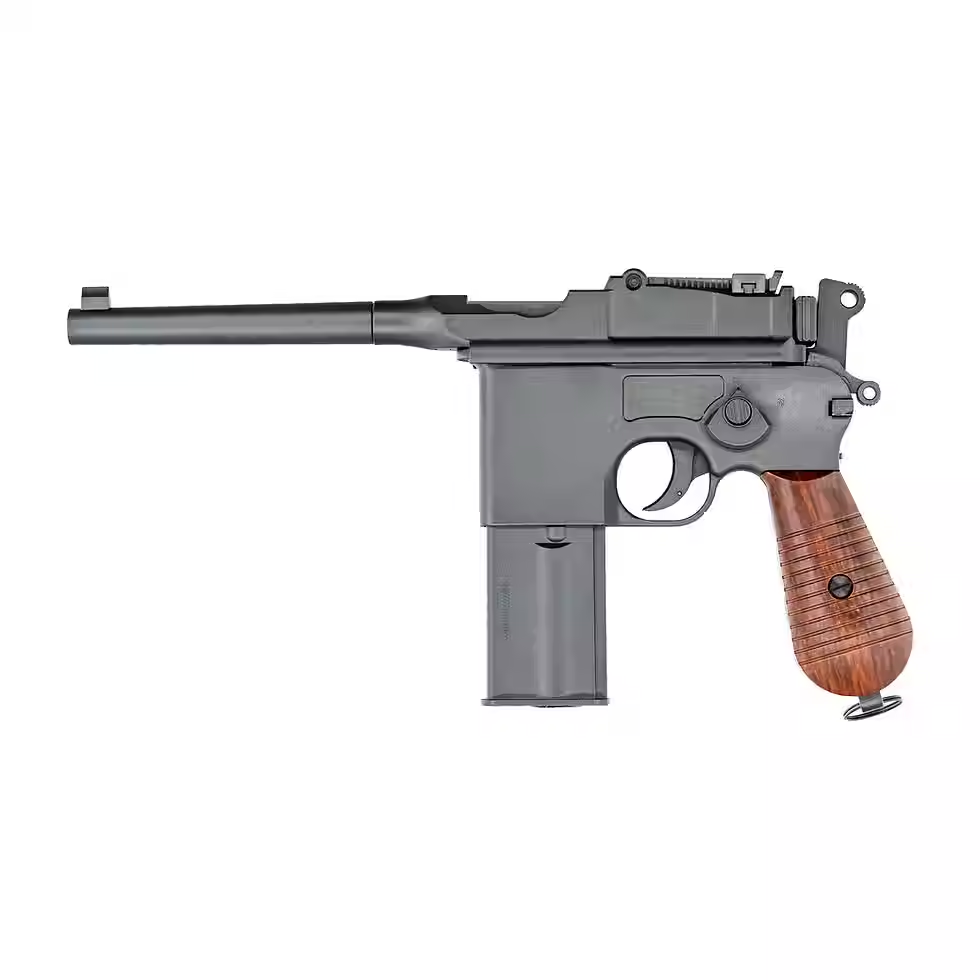
And finally, because no replica list would feel complete without one, the KWC M712 Broomhandle.
Is it powerful? Not really.
Is it the most accurate pistol we've ever tested? No.
Is it fun? Probably more than anything else on this list.
The M712 is one of those replicas where the sheer weirdness is part of the appeal. It looks completely different from almost everything else, has plenty of mechanical character and has been a favourite among replica enthusiasts for years. Sometimes that's enough.
The Bottom Line
Replicas aren't bad airguns.
They're just different airguns.
If your priority is accuracy, consistency and squeezing every last bit of performance from your ammunition, buy a gun designed around those objectives.
If your priority is owning something that looks like a particular firearm, has realistic controls, cycles when you fire it and makes you grin every time you pick it up, then a replica might be exactly what you're looking for.
Just remember what you're buying.
You're buying the replica of the experience, not necessarily the replica of the performance.
Image Use for Educational Purposes - This blog post includes images used for educational purposes, not all of which are not owned by the publisher. Efforts have been made to credit image owners/sources appropriately, and any concerns about attribution or copyright should be addressed by contacting us. These images are used solely for educational purposes within fair use guidelines, with no commercial intent. The inclusion of external images does not imply endorsement or sponsorship of our content by image owners/sources. We aim to comply with relevant copyright laws.





Also, BBs don't have to seriously bounce around. Copper coated lead BB's are available, and ricochet less than steel.
Plastic and frangible (Dust Devils) BBs are also available as lower ricochet alternatives.
They are more expensive, but far safer.
I personally no longer use steel BBs.
Great article, some good points raised and answered, as ever AAR top notch 👍